
The Evidence Race
I'll Be Gone in the DarkThis flow traces the conflict between fading, fragmented evidence and the evolving forensic methods that gradually connect the crimes without initially identifying the offender.
increasing Bearing strength in each event
 decreasing
Bearing strength in each eventdecreasingEvidence at the Scene
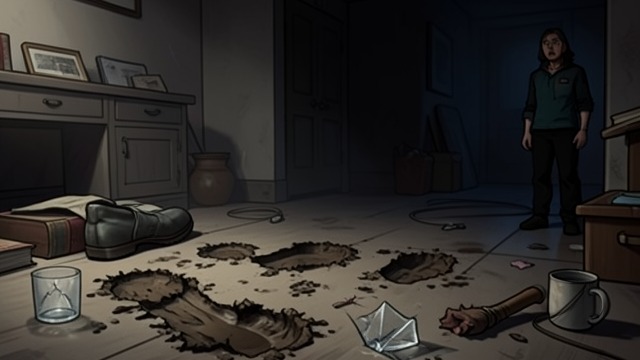
Clues Without a System
Physical Traces
Investigators collect shoe impressions, ligatures, stolen objects, biological samples, and witness descriptions from crime scenes across California. Each clue can be meaningful, but its value depends on careful preservation and a later ability to compare it with evidence from other cases.
Lost Opportunities
Departments do not always share information, and some evidence is destroyed under ordinary property-room procedures after cases grow cold or legal deadlines pass. Witness memories fade, descriptions conflict, and older reports remain buried in boxes. The offender’s movement across jurisdictions turns routine administrative choices into lasting obstacles.
The conflict is between the abundance of traces and the fragility of the systems meant to preserve them. Evidence exists, but it is scattered among agencies and technologies not yet capable of revealing the connections it contains.
Early DNA Promise
Old Evidence Becomes Useful
New Testing Methods
As DNA testing becomes available, the Orange County Crime Lab begins revisiting unsolved cases. Mary Hong uses newer PCR-STR techniques on samples that might be too small or degraded for earlier methods. The work offers a way to compare cases scientifically rather than relying only on similarities noticed by investigators.
A Connection Emerges
DNA from the Harrington and Witthuhn cases matches, and the profile also matches evidence from Janelle Cruz’s murder. The laboratory result links cases that investigators had not previously treated as part of one series and weakens the assumption that Janelle’s killer came from her immediate circle.
The breakthrough turns preserved biological evidence into a durable investigative lead. It does not yet provide a name, but it decisively challenges theories built around local suspects and separate crimes.
The Ventura Match
A Difficult Sample Speaks
Slides Instead of a Full Kit
Larry Pool asks Ventura investigators to send evidence from the Smith murders for testing. The package contains glass slides but not the more complete set of swabs the laboratory would prefer. Mary Hong nevertheless develops a DNA profile from the material, working with a sample whose limits make the result especially consequential.
Local Theory Challenged
The profile matches the Harrington, Witthuhn, and Cruz evidence and excludes Lyman Smith as the source. The result gives scientific support to the theory that the Smith murders belong to the same series. It also undermines the local case against Joe Alsip, whose prosecution had collapsed for reasons unrelated to DNA.
The conflict between old case narratives and biological evidence becomes sharper. A difficult, incomplete sample can still overturn assumptions that have shaped an investigation for years.
The Statewide Link
Northern and Southern DNA Align
A Confirmed Comparison
Once the Contra Costa laboratory can use STR typing, Paul Holes’s team compares its East Area Rapist profile with Orange County’s profile. The markers match, establishing that the Sacramento and East Bay assaults and the Southern California murders were committed by the same offender.
A New Scale of Investigation
The announcement transforms the case. Investigators now face a unified series spanning years and jurisdictions, with a strong DNA profile but no database identification. Survivors encounter the news unexpectedly in the press, while departments confront the scale of a case they had once approached in separate parts.
Scientific linkage resolves one central dispute and opens a larger one. DNA makes the offender’s continuity certain, but the ordinary criminal databases still cannot tell investigators who he is.
Genealogy’s Unsettled Promise
Beyond Criminal Databases
A New Search Strategy
Investigators and researchers explore Y-DNA databases and consider whether commercial genealogy platforms could help identify relatives of the unknown offender. Paul Holes receives a close Y-DNA match in 2013, but it turns out to be a mirror-image result caused by another researcher entering the same profile. Michelle McNamara likewise discovers that a distant genealogical match cannot identify a specific person.
The Privacy Boundary
By 2016, commercial databases contain far more profiles than law-enforcement databases, raising the possibility that a distant cousin could reveal a family line. The companies’ privacy policies and legal concerns obstruct direct use of those databases with crime-scene DNA. The proposed route promises reach but raises questions about consent and the limits of investigative authority.
The evidence race now includes a conflict between technical possibility and ethical or legal permission. Genetic genealogy may point toward a family, but the case has not yet crossed that boundary when the book’s account ends.
1976–1986
1996
1997–1998
2001
2013–2016
